
Uplifting ABA
Practical help with behavior, communication, and everyday routines
Books and guidebooks for families, and training resources for ABA teams. Written by Ricardo de la Peña, M.A., BCBA, LBA. Available in English and Spanish.
Find your starting point
Who are the resources for?
Families
Plain-language books and guidebooks for meltdowns, routines, communication, sleep, meals, and school. Useful with or without a diagnosis or services.
Clinics & RBT trainers
Staff training materials and a 41-topic bilingual caregiver education collection, licensed to organizations. Free sample handout to download.
The BCBA Residency
A case-based curriculum on clinical reasoning for student analysts, new BCBAs, and the supervisors and faculty who train them.
New · Free · English and Spanish
Behavior Buddy: one next step for a hard moment
Choose what's happening and when, and Behavior Buddy gives you one calm, practical step to try, simple words your child can use to ask for help, and one change for next time. It's built on the same ideas as the Empowered Parent Collection.
- No sign-up and no account. Open it and start.
- Works on your phone, in English or Spanish (tap ES at the top).
- Education, not therapy. It starts with a safety check and isn't for emergencies.
A free preview for parents and caregivers, using example situations.
Why I built Uplifting ABA
The foundations of ABA belong in everyday life
Behavior analysis is about ordinary moments: what happens right before and right after a hard moment, how a routine is set up, and how a new skill is taught one small step at a time. Those ideas help in a kitchen at 7 a.m. as much as they help in a clinic.
Many families never hear them explained in plain words, or in the language they speak at home, and many teams don't have time to build training from scratch. I built Uplifting ABA so the foundations are within reach for everyone: short books families can use on their own, in English and Spanish, and training that helps RBTs, BCBAs, and parents learn the same ideas in the same words.
Ricardo de la Peña, M.A., BCBA, LBA
Plain language
No jargon to decode. Every idea comes with steps to try, words you can use, and a real-life example.
English and Spanish
Every family book has a Spanish edition, so the language at your table never decides the quality of help you get.
Everyone learns the same thing
Staff training and parent training cover the same topics, so what a child practices in session is what the family practices at home.
Where to start
What I recommend
Three simple steps
- 1. Start free. Print the free Family Workbook and read a free sample of any book. You can see whether the approach fits your family before you spend anything. In the middle of a hard moment? Try Behavior Buddy, free.
- 2. Pick the book for what's hardest right now. Meltdowns and big feelings: When Big Feelings Take Over. Screens: The Hard Part Is Stopping. Everyday routines, behavior, and communication: The Empowered Parent Guidebook.
- 3. Share it with the people around your child. Bring the worksheets to your BCBA, therapist, or teacher so everyone follows the same plan. No services nearby? Each book works on its own and tells you when to ask for more help.
Three simple steps
- 1. Present the free PDU to your team. The Algorithm Is a Behavior Analyst is a complete in-service with a presenter script, slides, an activity, and a knowledge check, so your clinical leaders can judge the quality with your own staff.
- 2. Cover the RBT recertification cycle. The PDU Academy's 12 scripted in-services, one a month, cover the 12 PDUs RBTs need in each two-year cycle, with sign-in sheets and knowledge checks for your records.
- 3. Pair it with parent training. Each month's staff topic comes with matching parent training in English and Spanish, so families practice at home what your team practices in session.
Get the free PDU →
See the Academy →
For BCBAs and supervisors: the Residency →
Books & guidebooks
Start reading today
Every book has a free sample. Paperback, Kindle, or instant PDF, and each one is also available in Spanish.

The Empowered Parent Guidebook
Understanding behavior, supporting learning, and navigating everyday routines. 50 short chapters on mornings, homework, siblings, screens, sleep, meals, and more, with steps to try and words you can use. For families with or without a diagnosis, and with or without services.
Read sample pages free (PDF) · Paperback $35.99 & Kindle $12.99 on Amazon
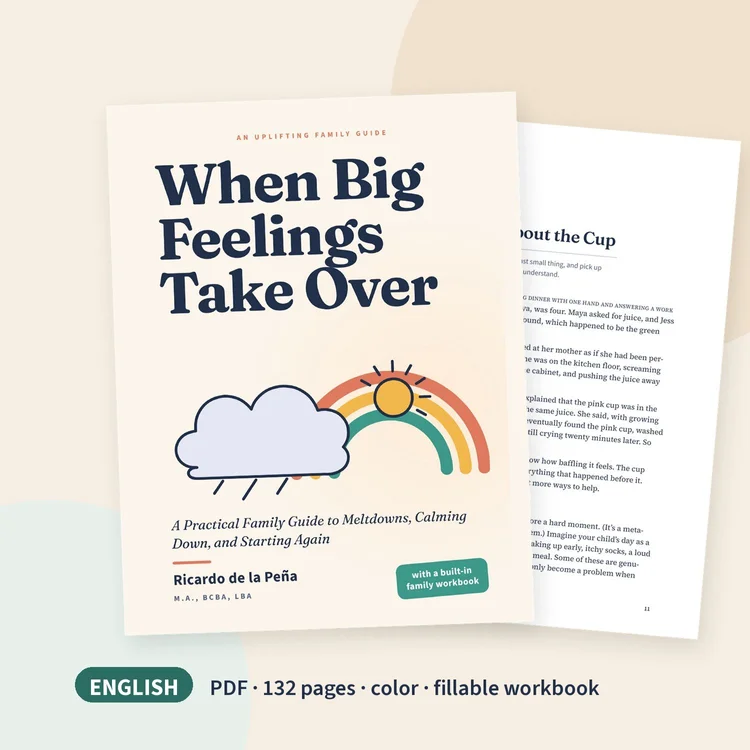
When Big Feelings Take Over
A practical family guide to meltdowns, calming down, and starting again, for parents of toddlers through elementary-school kids. A plan for before, during, and after the storm.
Read chapter 1 free (PDF) · Paperback $24.99 & Kindle $12.99 on Amazon

The Hard Part Is Stopping
A practical family guide to screen time, limits, and turning it off with less fighting. For parents and caregivers of children about 2 to 10, with or without a diagnosis.
Read chapter 1 free (PDF) · Paperback $29.49 & Kindle $12.99 on Amazon
Free · Gratis
The Family Workbook is free to print
19 printable planning pages and kid pages from When Big Feelings Take Over, in English and Spanish. No sign-up needed.
Questions
Good to know
What is ABA, in plain words?
Applied behavior analysis (ABA) studies how behavior relates to what happens around it, and uses that knowledge to support changes that matter in a person's life. At home, that means looking at what happens before and after a hard moment, making routines clearer, and teaching useful skills in small steps.
Are these resources only for autism?
No. The ideas work for any family dealing with everyday behavior, routines, and learning, with or without a diagnosis. Some chapters include extra ideas for children who need more support.
Is this therapy?
No. These are educational resources. They don't diagnose or treat, and they don't replace a professional who knows your child. Each book explains when to ask for more help.
Should I get the paperback, the Kindle, or the PDF?
The paperback is easiest to read and keep on the shelf. Kindle works on your phone. The PDF downloads instantly and lets you print the worksheets as often as you need for your own family.
Can our clinic share the family books with the families we serve?
Families can buy the books on their own. To share the files or worksheets with several families, or to use them in a school or clinic, you need an organization license. Write to hola@upliftingaba.com.
Are the PDUs approved by the BACB?
Uplifting ABA Academy materials are independently developed and are not sponsored, approved, or endorsed by the Behavior Analyst Certification Board (BACB). Organizations are responsible for confirming current BACB requirements at bacb.com.
How do I contact you?
Email hola@upliftingaba.com. Please don't send client names, clinical records, or health information.
Who writes these
Ricardo de la Peña, M.A., BCBA, LBA

Ricardo is a Board Certified Behavior Analyst and a Licensed Behavior Analyst in Texas, with over ten years of experience helping children communicate, learn everyday skills, and get through hard moments.
He created Uplifting ABA to make practical, bilingual education for families and for the professionals who support them. His approach is simple: understand what's happening, make the next step doable, and keep the relationship at the center.
These resources are education, not diagnosis or treatment, and they don't replace care from a professional who knows your child. If anyone is in immediate danger in the U.S., call 911.